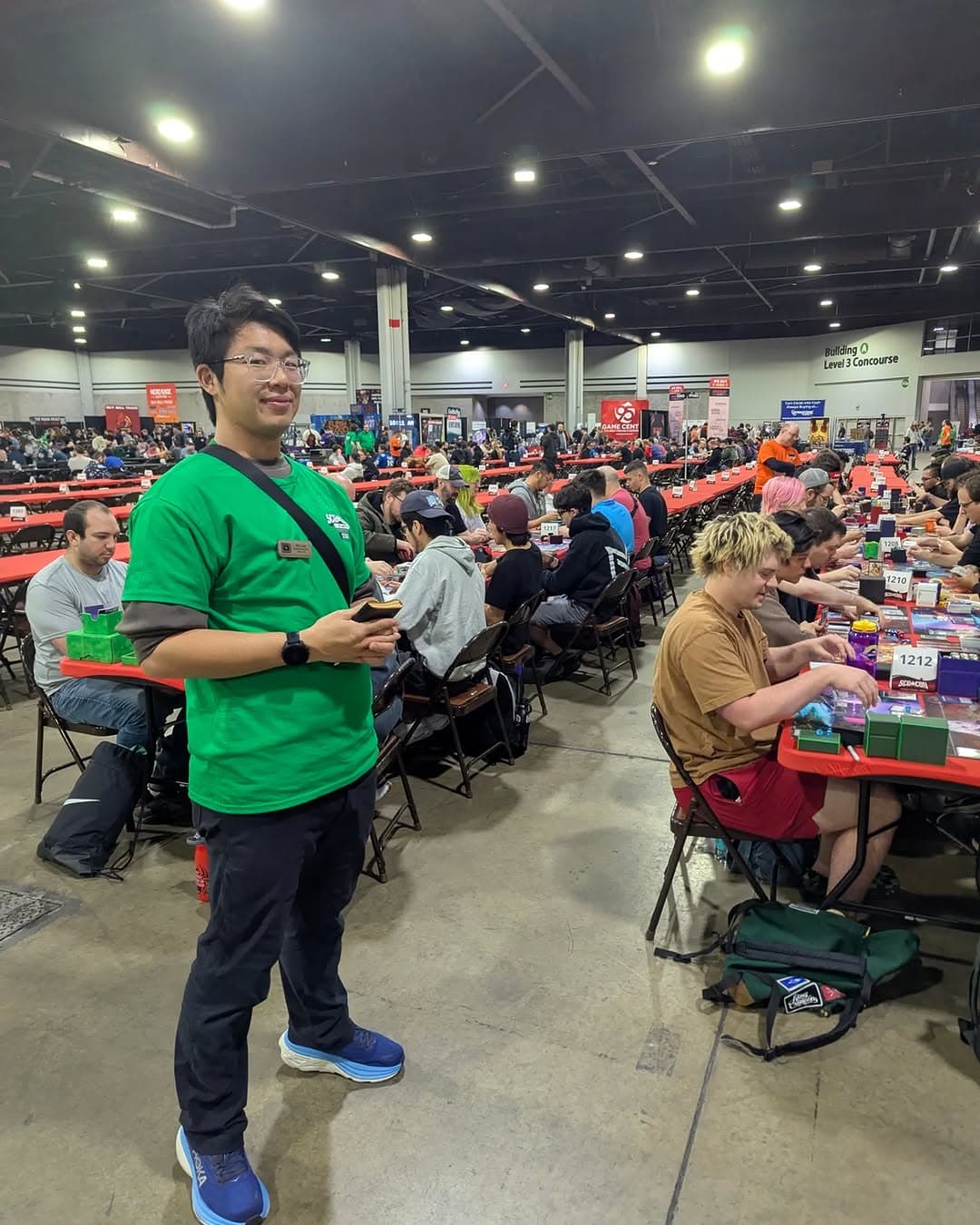
Greetings Judges!
It was a privilege to kick off the new year 2025 as a floor judge at the SCG Con Atlanta Battle Hardened 1/4/25, and PQ+ 1/5/25 at the Georgia World Congress Center, a very large venue. My head judge was Steven Zwanger, and I worked with Arturo Alvarado, Kate Wescott, Shuto Hagiwara, & Matt Muckle.
I had some paper duties day 1 and 2 and some deck check duties on day 2.
Extensions and Procedure and Penalty Guide (PPG) Records
We used discord channel for penalties and round timers, and used a discord thread to keep the noise separate for time extensions for our EOR Lead.
Deck Check Results and Selections
Matt M was Deck Checks Lead on Saturday with Hagiwara as Deck Check FJ, and Hagiwara was Deck Checks Lead on Sunday.
Matt M and Hagiwara focused on the swoop and deck checks on Saturday, and I assisted with deck checks on Sunday. We kept the records on the side, indexed by Round 1 table #, since decklists would be easily collected in order this way. It was quite fast compared to the alphabetical ordering used at a previous event I worked at.
Judge Responsibilities
Paper
The staff at SCG Con made the logistics for scorekeeping and paper pairings easy. Start time was 9AM for both events, and we kicked off pairings without any delay.
Flipping the round, I would take the pairings and put them up on the board, while our head judge would make announcements and kick off the round.
Bonus: For the PQ+, when the head judge entered break, I had the opportunity to speak on the big boy mic on stage to announce R5 pairings. It was surreal to hear my voice boom across the hall that not only had Flesh and Blood, but other TCGs in the room.
End of Round
Arturo was the EOR lead for the BH. We didn't have one assigned for the PQ+ since the crowd was smaller.
Atlanta Battle Hardened
We had 124 players join.
Round 1
Late Decklists 🏃♂️
There were several players that arrived late without decklists, and we had to issue IP2s for these players.
One of the players came up to me asking about decklists, as people were sitting down at their tables. I told them to quickly go and get a decklist from the stage to fill out, since the round had started, but forgot to inform them that they would receive a Tardiness penalty for not being ready to play.
Later, after the round started and decklists were collected, I realized that the IP2 penalty had not been issued to the player I had talked to, and they were prepping to play with their decklist in front of them. I called the head judge over with me to inform them of the infraction, and issue the penalty. The player was displeased because he believed that he would not receive an infraction since he had talked to a judge beforehand. Unfortunately, the infraction still had to be issued since he was not ready to play at start time. I apologized to him and took note to inform players in the future who are rushed that not having a decklist would ensure an IP2.
I discussed with my Head Judge and they mentioned that even though some players completed their decklist after 10 mins, they would not be issued a match loss, as it would be a negative customer experience, and we would stick with an IP2.
Round 2
Gone in a Flash & Reaction Resolutions ⚡
Tyler is playing Aurora against Nic who is on Viserai, and calls a judge. After attacking with Gone in a Flash, Nic has played Sigil of Suffering (red), and the defense reaction is on the stack. Tyler asks if he responds with an instant, and returns Gone in a Flash back to hand, would Sigil of Suffering still deal 1 arcane damage.
After looking at CR 7.8.3:
7.8.3 First, the "combat chain closes" event occurs and effects that trigger from the combat chain closing are triggered. All attacks and reactions on the stack are put into their owner's graveyard.
Even though Sigil of Suffering's text only says "deal 1 arcane damage", since Sigil of Suffering goes to the graveyard, the defense reaction does not resolve, and so arcane damage would not be dealt.
Instant Silver Error 🪙
Nic playing Nuu is playing against Tyler who is on Zen. Nic has a Silver, but doesn't have the actual card on hand and can't remember how Silver is used, and chooses to pay the cost of the Silver, using its activated ability as an instant. After drawing, he blocks with a card, leaving one card in hand, and then calls a judge to inquire Silver's text, and discovers they used Silver incorrectly.
As the penalty was Hidden Card Error, and the opponent cannot verify which card was drawn, we reveal the card in hand and the card used to block to the opponent as we cannot confirm which card was drawn. The opponent gets to choose which card is put on top or bottom. We then do a partial rewind, returning the card pitched for silver back to hand, and move back to defense for blocks.
Round 3
Forgotten Intimidated Card 😢
Nic was intimidated, left with no cards in hand, and Tyler forgets to have the intimidated card returned to the hand at the end of the turn. Nic, the intimidated player, later draws up to hand size, forgetting the intimidated card, realizes and calls a judge.
Drawing too many cards at the end of one's turn is Hidden Card Error (HCE). The proper fix is to reveal the hand and have the opponent choose the extra cards, putting each on the top or bottom of the deck. Cards known to have been added to the top of the deck before drawing — the opponent can't choose such cards.
I accidentally included the intimidated card in the revealed set, though the opponent did not choose the intimidated card as well as any other known cards placed on the top of the deck, and the game resumed. I was informed by the head judge that I had applied the incorrect fix, and that the HCE remedy is applied only to the smallest set of affected cards, which I took note for the future.
Top 8
Reverse Reverse: Rewinding Actions ⏪
One specific circumstance occurred in Top 8 where a player asked if they could rewind and respond after a certain number of actions that were acted without any acknowledgement of plays made:
Tyler plays Rattlebones, targets a 1 cost runeblade card in Graveyard and banishes a 1 cost runeblade card from graveyard, activates tunic, and attacks Nic who has not acknowledged any actions Tyler has made since Rattlebones. Nic then calls a judge and asks about Pass Over's ability and if banishing a target card in the opponent's graveyard would prevent a card from resolving. After being informed that it would, he asks if there's a possibility for rewinding.
After some investigation, it was noted that since Nic had not given any acknowledgement of Tyler's action, a rewind was possible, and Nic could respond.
Tyler is visibly upset, as he believed he played at a reasonable pace and gave adequate amount of time in between plays. But since no acknowledgement of passing priority was given, and we want to facilitate a game to be interactive, we educated Tyler that in the future, it is important to get a response when passing priority — especially when the opponent may have an opportunity to respond, even if it's to the detriment of the player.
Atlanta Sunday PQ+
We had a total of 40 players.
Round 1
Search Me Zen 🔍
Tyler activates Zen ability, searches the deck and reveals a combo card, but no further action is taken and the opponent gives no acknowledgment. Afterwards, the player calls the judge and asks if it's possible to search a different card in the deck. Since the player has not taken any further action, and revealing the card does not give any particular advantage to the Zen player, it was allowed for the Zen player to search the deck for another card.
Who's Got Priority, Dash I/O 👀
Tyler on Dash I/O asks if there is a moment to play a card on top while resolving Spark of Genius. We informed the player that even though Dash I/O can look at the top of the deck, you are only able to play a card on top when there is priority. When resolving effects or abilities, especially those that interact with the deck, there is no priority until an effect fully resolves and therefore cannot play that card until there is priority.
We also informed the player that they could not look at the card while Spark of Genius was resolving. This is in reference to the CR on "look":
8.5.11d If look is a continuous effect and the object is specified by a location, the object the player may look at are determined as a game state action. If the object a player may look at changes due to a rule or effect, the player may not look at that new object until any player would gain priority.
To Crank, or not to Crank ⚙️
Tyler on Dash I/O asks if there is a time before crank to look at the card on top. We informed the player that since Dash I/O's looking top card on the deck is static, and crank is a replacement effect, there is nothing stopping from looking at the top of the deck before making a decision to crank or not to crank.
Round 2
Where's the Equipment 🤔
Player on Viserai plays several turns in a game before realizing that his equipment has been left face down throughout the game. Penalty of Hidden Card Error is issued since the player presented his equipment face down, no equipment is legal in the given hero to be face down during the match, and leaving equipment face down may provide a strategic advantage against the opponent, as they may not be able to make informed decisions knowing opponent's equipment. The fix based on PPE is to remove the facedown equipment cards.
Round 4
End Phase Priority ❓
Nic asks about responding to the Seek and Destroy trigger at the beginning end phase with Backup Protocol:Red. We explained that the end phase has no priority, and informed the player that if they wanted to activate Backup Protocol:Red, they would need to respond with it at the end of the Action Phase.
Afterwards he asked if he could appeal to the head judge who was on break. I mentioned I would consult with another judge. Afterwards, I pulled up the comprehensive rules and showed the player the exact rulings about start and end phases having no priority, as well as the blurb talking about "beginning of end phase" procedure.
I learned personally that for better customer service, to make sure to consult with another judge, and to not take offense if a player wants a ruling explanation from others.
The Correct "Warning" ⚠️
Tyler partially resolved a Malefic Incantation, creating a Runechant but not removing a counter. I informed the player and they ticked down the trigger, but failed to explain the penalty and give a warning.
I was informed by the head judge later that the purpose of issuing Warnings is educational — to make the player more likely to play more carefully than if a judge simply fixes the error.
Round 5
Game Rule Violation on Judge 🟥
Tyler on Nuu and Nic on Zen are playing an intense game with several minutes left on the clock. Tyler attacks with a Beckoning Mistblade, who responds in reaction step with A Drop in the Ocean. Tyler responds to the instant by breaking Arousing Wave, and reacting with Fang Strike, which can only interact with attack action cards.
One of the judges notices a potential issue and tries to step in, but I make a mistake interjecting saying that Arousing Wave can react on weapons and also it applied to Fang Strike. The other judge in the moment agrees, and the game continues.
Later after the game was finished and the following round was paired, I was informed that I had made a game rule violation, and afterwards informed both Tyler and Nic of the mistake and the correct game rules interaction, and apologized. Fortunately they both took it without any issue, and I was challenged to not be affected by time — since as a judge, I could always issue more time extensions, and it's okay to take the time to be thorough during investigation.
There were no noticeable calls or issues for the rest of the rounds and my shift was over by the time Top 8 started.
Conclusion
Overall, I learned a lot judging one of my first official big events as an L2, and I was very privileged to work with the other judges on my team and learn from them all. Hopefully you were able to learn and glean something from the many different calls and interactions, and till next tournament report 🫡